
Can You Crack NATA 2026 at Home? Yes, If You Follow This Month-by-Month Study Plan
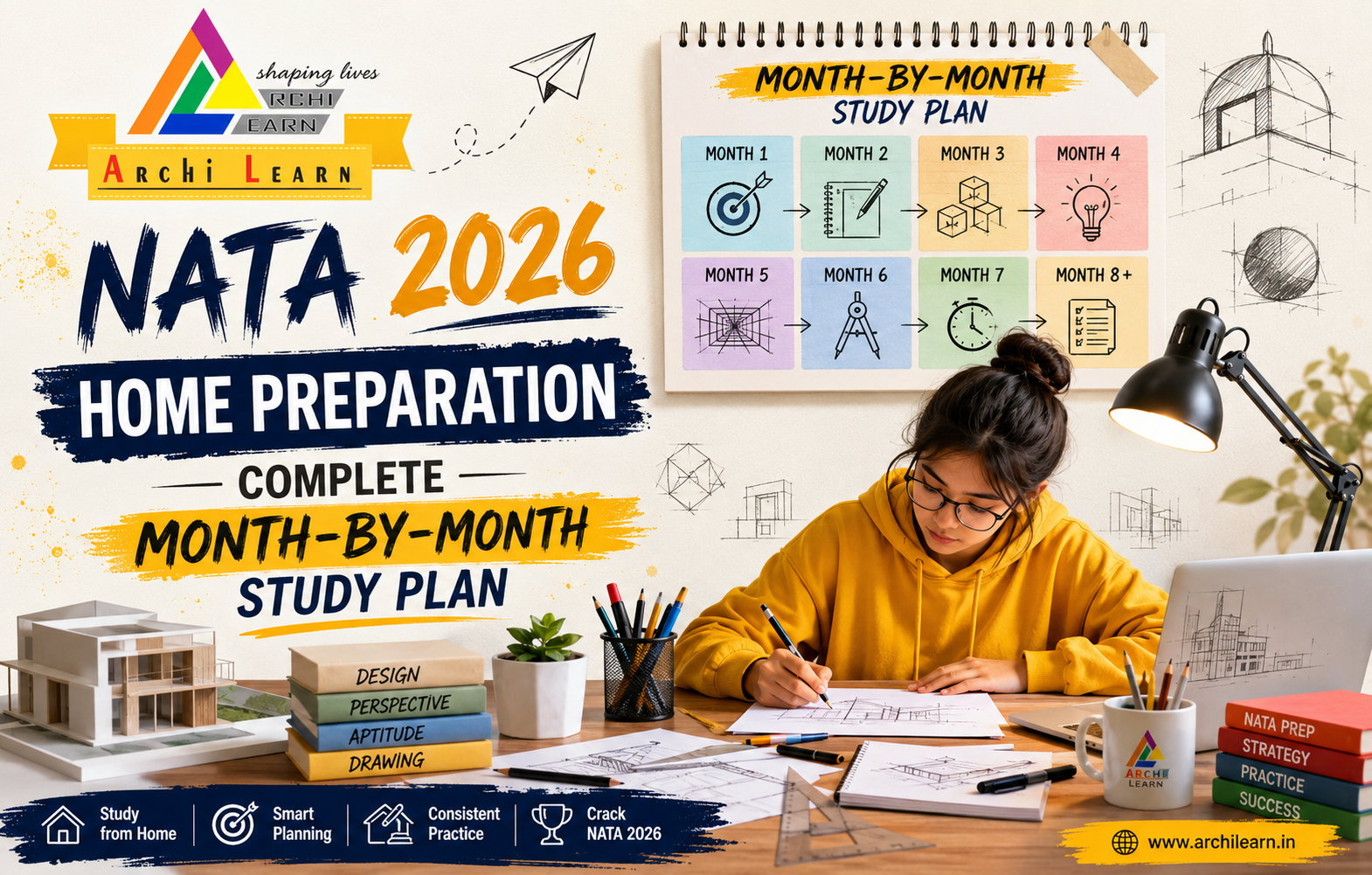
Every year, thousands of aspiring architects stare at the NATA registration form and ask the same question: do I really need to spend ₹50,000 on coaching, or can I prepare at home and still make it? The answer depends less on whether you join a class and more on whether you have a plan. Students who fail NATA at home usually fail because of scattered preparation, not lack of talent. This guide gives you a complete, battle-tested NATA 2026 preparation roadmap - with a month-by-month study plan, a daily schedule, drawing practice tips, and the exact resources you need to prepare for NATA without coaching and clear it with confidence.
SYMPTOM-TO-SOLUTION MATRIX
What Is the NATA 2026 Exam Pattern, and Why Does It Matter for Home Preparation?
The NATA 2026 exam is a national-level architecture entrance test conducted by the Council of Architecture. Understanding its structure before building your study plan is non-negotiable - the two parts of the exam require completely different preparation strategies.
The exam has two parts. Part A is the drawing test, a 135-minute paper where you sketch, render, and compose visual scenes by hand on paper provided at the centre. Part B is a computer-based aptitude test covering mathematics, general aptitude, logical reasoning, and aesthetic sensitivity, lasting 45 minutes. Together, the total marks are 200.
There are two main reasons home students underperform. First, they treat Part A as a talent test rather than a skill test. Second, they underestimate how much the aptitude section overlaps with Class 12 board maths. Both mistakes are fixable with the right preparation for NATA 2026.
Key structure at a glance:
Part A (Drawing): 135 minutes, 2 questions, 80 marks total
Part B (Aptitude + Maths): 45 minutes, MCQs and NAT questions, 120 marks total
Minimum qualifying marks: Varies by category; check the official CoA notification
Mode: Part A is offline (pen and paper); Part B is online (computer-based)
How Do You Prepare for NATA 2026 Step by Step? The Complete Month-by-Month Plan
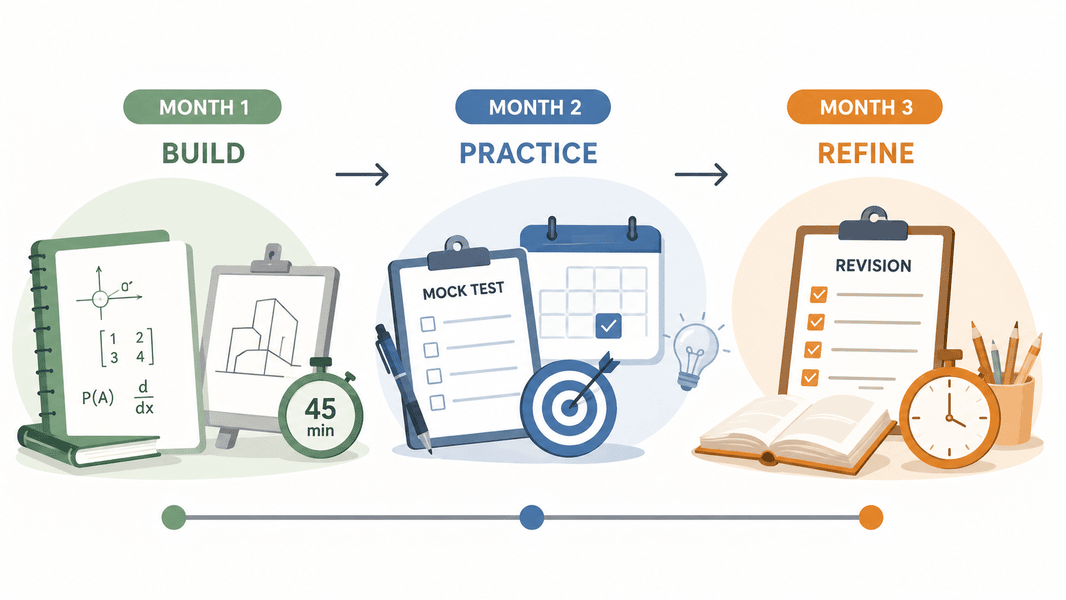
The NATA 2026 home preparation plan comes in three versions depending on how much time you have. Pick the one that matches your start date. All three share the same core structure - the only difference is how many revision cycles you complete.
6-Month NATA Study Plan (Best for Beginners Starting in February 2026)
Month 1 (February): Build the Foundation
Start with the basics of both sections simultaneously. Do not attempt past papers yet.
Mathematics: Complete NCERT Class 11 Chapters 1-7 (Sets, Relations, Trigonometry, Complex Numbers, Sequences). Solve all NCERT exercises - not just examples.
Drawing: Practice freehand lines, basic geometric forms (cube, sphere, cylinder, cone), and value scales (light to dark in 5 steps). Spend 10 minutes daily on observational drawing - draw one object near you each morning.
Aptitude: Start a vocabulary and reasoning notebook. Record 5 new architectural or general-aptitude terms daily.
Month 2 (March): Deepen Both Sections
Mathematics: Complete NCERT Class 11 Chapters 8-16 (Permutation, Binomial, Coordinate Geometry, Conic Sections). Begin Class 12 Chapters 1-4 (Relations and Functions, Matrices).
Drawing: Move to 2-point perspective drawing. Practice drawing rooms, street scenes, and furniture. Use grid paper initially; shift to blank A4 sheets by Week 3.
Aptitude: Begin past question analysis for the aesthetic sensitivity section. Identify which architectural styles and movements appear most frequently.
Month 3 (April): Introduce Timed Practice
This month, speed becomes part of your practice. Untimed preparation has a ceiling.
Mathematics: Complete Class 12 Chapters 5-13 (Calculus, Vectors, 3D Geometry, Probability). Begin timed chapter-level quizzes - 25 questions in 30 minutes.
Drawing: Practice composition problems. Set a timer for 45 minutes and produce a complete rendered scene. Focus on balance, focal point, and texture variation.
Aptitude: Attempt your first full Part B mock. Review every wrong answer. Categorise errors: concept gaps, careless mistakes, or time pressure.
Month 4 (May): Revision and Weak Area Attack
Mathematics: Revise all formula sheets. Focus 80% of your time on your weakest three chapters.
Drawing: Practice NATA-style prompts. Examples: "Draw a street corner with a food cart and two people, "Sketch a living room in natural light." Collect 10 prompts and rotate through them.
Aptitude: Take two full-length Part B mocks per week. Track your score trend across attempts.
Month 5 (June): Full-Length Mock Integration
By now, you should be attempting integrated full-paper mocks every week.
Take one full NATA mock (Part A + Part B) every Saturday under strict exam conditions.
On Sundays, do a deep review. Do not just check answers. Recreate wrong drawings. Rework maths problems from scratch without looking at solutions.
Use weekdays to patch specific gaps identified from Saturday mocks.
Month 6 (July): Final Sprint
No new topics. Revision only.
Drawing: Revisit your Month 1 drawings. The improvement you see will sharpen your confidence.
Mathematics: Run through all formula sheets daily in 20 minutes.
Aptitude: One mock every three days. Prioritise accuracy over speed.
Sleep, diet, and mental rehearsal matter as much as subject revision in this final month.
3-Month NATA Study Plan (For Students Starting in May 2026)
Month 1 (May): Compressed Foundation
Cover the full mathematics syllabus in four weeks. Three chapters per week. Prioritise: Coordinate Geometry, Probability, Matrices, and Calculus. For drawing, skip gradual exercises and move directly to timed compositions from Week 2. Two drawing sessions of 45 minutes each per day.
Month 2 (June): Mock-Heavy Practice
Three Part B mocks per week. One full integrated mock per week. Identify your five weakest aptitude question types. For drawing, practice minimum 10 NATA-style prompts using a timer. Collect feedback from a teacher, mentor, or trusted peer.
Month 3 (July): Seal the Gaps
Final revision only. No new topics. One full mock every three days. Drawing practice drops to one timed session per day to preserve mental energy for revision.
1-Month NATA Study Plan (For Last-Minute Preparation)
This plan is high-intensity and non-negotiable in its discipline.
Week 1: Mathematics formulas only (no full chapter revision), full Part B mock on Day 3 and Day 7. Drawing: one 45-minute timed composition per day.
Week 2: Aptitude focus. Solve 50 past MCQs per day. Drawing: two timed compositions per day using prompts from previous NATA papers.
Week 3: One full integrated mock every two days. Deep review after each mock. Zero new topics.
Week 4: Light revision, mock on Day 26, rest and mental preparation for the final two days.
What Does an Effective Daily Study Schedule for NATA Look Like?
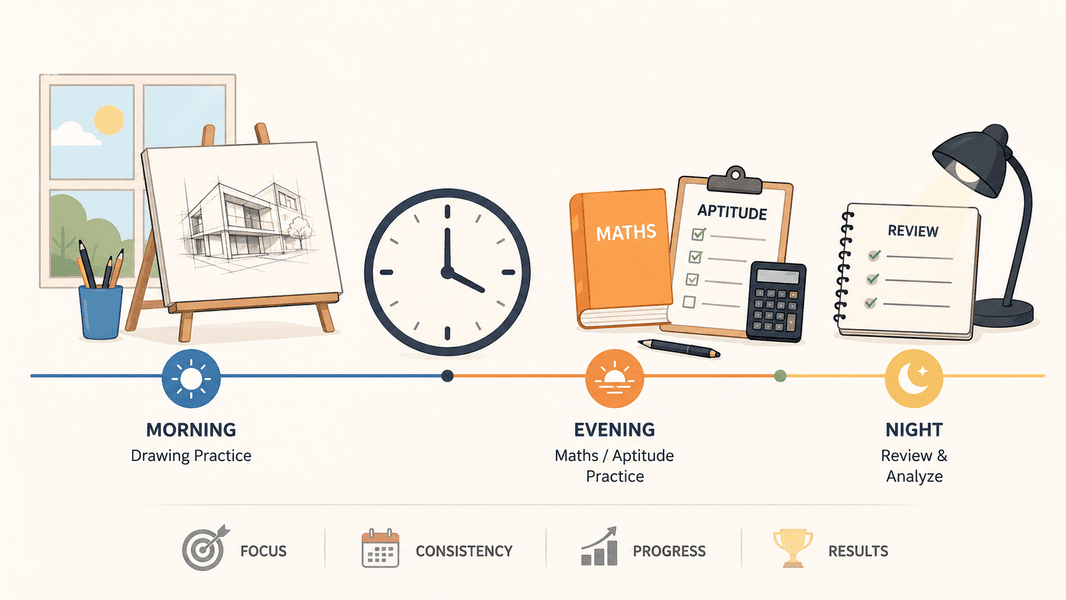
A good daily schedule for NATA 2026 home preparation separates drawing and aptitude into two distinct sessions. Mixing them in the same sitting reduces focus on both.
Sample Daily Schedule (3.5 Hours Total):
Keep drawing in the morning when your visual imagination is freshest. Mathematics and aptitude work well in the evening when analytical thinking peaks. The most common mistake self-study students make: they study when they feel like it, not on a fixed schedule. Discipline is the actual differentiator.
How Do Beginners Improve Their Drawing for NATA?
The drawing section of NATA 2026 is not a fine arts test. It rewards structured thinking, clear composition, and the ability to communicate space and volume visually. Three core skills decide your Part A score: perspective, proportion, and rendering.
We identify five drawing practice habits that work best for NATA beginners.
1. Daily Perspective Drills (15 Minutes) Draw a box in 1-point perspective, then 2-point. Do this every single day. Perspective accuracy is the first thing evaluators notice.
Pro Tip: Use a ruler for your horizon line and vanishing points only. All other lines should be freehand. This builds speed without sacrificing accuracy.
2. Observational Drawing (10 Minutes) Pick one household object - a chair, a lamp, a window frame - and draw it as accurately as you can. No artistic interpretation. Pure observation. This trains your eye-to-hand coordination faster than any other exercise.
Common Mistake: Drawing from imagination instead of observation in early practice. Imagination drawing should come after observational skill is strong, not before.
3. Light and Shadow Practice (20 Minutes) Shade a cube with a single light source from the upper left. This one exercise, done daily, develops your understanding of volume faster than any YouTube tutorial.
4. Texture Rendering (15 Minutes) Practice rendering brick, glass, wood, and foliage using different pencil pressures. NATA compositions almost always include architectural materials. Knowing how to suggest texture quickly separates average drawings from high-scoring ones.
5. Full Timed Compositions (45 Minutes) From Month 2 onward, dedicate one full drawing session to a timed NATA-style prompt. The topic does not matter as much as the habit of working fast and decisively under a clock.
Which Maths and Aptitude Topics Are Most Important for NATA 2026?
The aptitude section of NATA 2026 draws almost entirely from NCERT Class 11 and Class 12 mathematics. There are no shortcuts here. The syllabus is wide, but several chapters appear more frequently in past papers.
High-Priority Mathematics Topics:
Coordinate Geometry (Class 11): Lines, circles, parabola
Matrices and Determinants (Class 12): Properties, operations, solutions of equations
Probability (Class 12): Bayes' theorem, conditional probability
Three-Dimensional Geometry (Class 12): Direction cosines, planes
Vectors (Class 12): Dot product, cross product, scalar triple product
Calculus (Class 12): Limits, derivatives, applications, integration basics
High-Priority General Aptitude Topics:
Architectural awareness: Identify buildings, materials, structural systems
Visual and spatial reasoning: Mirror images, 3D folding, pattern completion
Logical sequences: Number series, analogies, odd one out
Colour theory: Warm/cool contrasts, complementary pairs

According to the Council of Architecture's official NATA 2024 brochure, the aptitude section tests "mental ability, visual perception, and aesthetic sensitivity" alongside mathematics. This means rote formula memorisation alone will not carry you - build visual reasoning habits alongside maths revision.
What Are the Best Free Resources and Books for NATA 2026 Self-Study?
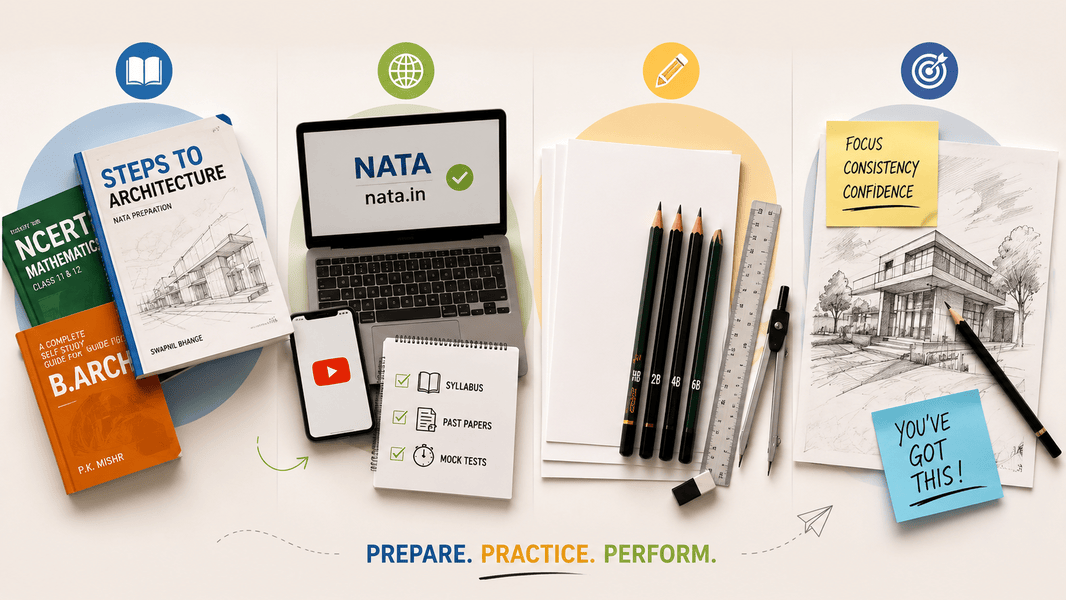
The best resources for NATA 2026 home preparation are a mix of free and paid, digital and physical. You do not need all of them. You need the right ones, used consistently.
Books (Paid, Worth It):
"Steps to Architecture" by Ar. Swapnil Bhange: Comprehensive NATA prep book with drawing exercises, aptitude questions, and past papers. Widely used by self-study candidates.
NCERT Mathematics Class 11 and Class 12: Non-negotiable. Solve every exercise, not just examples.
"A Complete Self Study Guide for B.Arch" by P.K. MishrStrong for aptitude and reasoning sections.
Free Online Resources:
NATA official website (nata.in): Download the official syllabus and past papers. Always use official papers over third-party compilations.
YouTube channels covering architectural drawing and NATA tips: Search for NATA drawing tutorials specifically, not generic art tutorials.
CoA mock test portal: Attempt the sample tests available on the official portal at least three times before your exam.
Practice Tools:
A4 paper in bulk (plain, not lined): Your most important tool for drawing practice.
HB, 2B, 4B, and 6B pencils: Different grades for line work and shading. Avoid mechanical pencils for NATA drawing practice.
A drafting scale and compass: For technical drawing exercises only. NATA drawing is freehand, but tools help you understand proportion.
KEY TAKEAWAYS
What You Need to Know
NATA 2026 has two parts: Part A (drawing, offline, 135 minutes) and Part B (aptitude + maths, online, 45 minutes). Each requires a distinct preparation strategy.
Home preparation for NATA works when it is structured. Students who fail at home fail because of scattered effort, not lack of ability.
Daily drawing practice of at least 90 minutes is mandatory for Part A improvement. Talent is a myth here - skill is built through repetition.
The maths syllabus for NATA Part B maps almost entirely to NCERT Class 11 and Class 12. Completing all NCERT exercises is sufficient to cover the topic range.
Full-length timed mocks should begin no later than Month 3 of your preparation, regardless of how much content you have covered.
Free resources (official past papers, NCERT books, the CoA portal) are sufficient to score well. Paid books add structure but are not essential for high scorers.
EXPERT NOTE
Practitioner's Observation: In NATA drawing evaluations, the most consistent differentiator between average and high-scoring papers is not artistic quality, it is decisiveness. Evaluators can spot a student who second-guessed every line. A bold, slightly imperfect drawing with clear spatial hierarchy will outscore a hesitant, technically correct sketch almost every time.
When Is NATA 2026 Home Preparation Not the Right Choice? Honest Limitations
Self-study has real limits. If your Class 12 maths foundation is genuinely weak (below 60% in board exams), structured coaching for the maths component will save you months of wasted effort. Students who have never drawn seriously before and have fewer than eight weeks to the exam also benefit from guided drawing correction that a book or YouTube video cannot provide.
What Do Critics of NATA Home Preparation Say?
Some coaching institutes argue that NATA requires personalised drawing feedback that no book can replicate. They are partially right. Feedback from an experienced evaluator does accelerate improvement. The question is whether that benefit justifies the cost and time of full-time coaching.
The honest answer: it depends on where you are starting from. A student with a decent drawing base and strong maths can crack NATA 2026 at home without any coaching. A complete beginner with less than three months to the exam will benefit from at least a short-term guided drawing correction programme.
There is a middle path. Many platforms, including Archi Learn, offer demo classes and targeted modules that give you the feedback advantage without a full coaching commitment. That option is worth exploring before you decide either way.
CONCLUSION
Building your own NATA 2026 study plan is not about discipline alone - it is about knowing exactly what to practice, in what order, and for how long. The month-by-month roadmap, daily schedule, and drawing drills in this guide give you everything you need to start today. Pick the timeline that fits your situation, commit to daily practice without skipping drawing sessions, and take your first full mock within the first three months. If at any point your drawing scores plateau or your maths revision hits a wall, that is the signal to bring in targeted guidance, and see whether structured feedback accelerates what you have already built on your own. The students who crack NATA 2026 preparation at home are the ones who treat it like a job from Day 1 - consistent hours, honest self-assessment, and a plan they actually follow.
Need help choosing the right coaching path?
Speak with the ArchiLearn team for personalised course guidance, exam planning, and architecture career support.

Comment Section
No comments yet.