

NATA Coaching vs Self-Study: Here Is What Students Who Actually Topped the Exam
You have two months before NATA registration closes, and one decision that feels bigger than the exam itself - do you pay for coaching or prepare on your own? The stakes are real. The problem is that most advice on this topic comes from either coaching centres trying to sell you a seat or self-study advocates who got lucky and generalised their experience. This guide cuts through both sides. We looked at what high-scoring NATA students actually did, where each approach breaks down, and what the right choice looks like for different starting points. By the end, you will have a clear answer for your specific situation - not a generic one.
SYMPTOM-TO-SOLUTION MATRIX
What Can Self-Study Actually Achieve for NATA Preparation?
Self-study can take you surprisingly far in NATA preparation - further than most coaching institutes will admit. The ceiling is real, but it is not where most people think it is.
We identify three areas where self-study produces genuinely strong results.
Mathematics and Aptitude (Part B): The Part B syllabus maps almost entirely to NCERT Class 11 and 12. A student who works through every NCERT exercise, attempts past papers, and tracks errors in a notebook can reach 85–90% accuracy in this section through self-study alone. No coaching required.
Logical Reasoning and Visual Perception: These skills improve with structured daily practice. Pattern completion, mirror image problems, and architectural awareness questions respond well to repeated exposure. Free resources - including the official NATA sample papers on nata.in - are sufficient to cover the full question range.
General Study Discipline: Students who build a fixed daily schedule and stick to it for three to six months often outperform coached students who treat classes as a substitute for personal practice. A coaching class is two hours. The remaining twenty-two hours of the day are still yours to waste or use.

The honest limit of self-study is not maths. It is not aptitude. It is the drawing section - and that deserves its own section.
Where Does Self-Study Fail? The Drawing Feedback Gap
The single biggest weakness of self-study for NATA is the absence of corrective feedback on drawings. This is not a minor gap. It is the gap that decides whether you score in the top 10% or the middle 50%.
Here is why it matters. When you practice drawing alone, you develop habits - some good, some counterproductive. You start defaulting to the same compositions, the same shading style, the same spatial relationships between objects. Without someone who knows how NATA papers are evaluated pointing out what is structurally wrong, you do not fix those habits. You repeat and reinforce them, every single day, across every practice session.
The specific problems that go undetected in solo drawing practice are proportion errors in perspective, over-rendering foreground elements while leaving backgrounds flat, and missing the compositional balance that NATA evaluators are specifically trained to notice. You cannot catch these in a mirror. You need eyes that know what to look for.
A student practicing alone for six months may produce technically cleaner drawings than they started with, but still make the same compositional decisions that drag scores into the 40–50 range out of 80. That is the drawing feedback gap. It is invisible until your result arrives.
What Does NATA Coaching Actually Provide That Self-Study Cannot?
The value of NATA coaching comes down to three things that are genuinely hard to replicate alone. Everything else - content delivery, syllabus coverage, practice papers - you can do yourself.
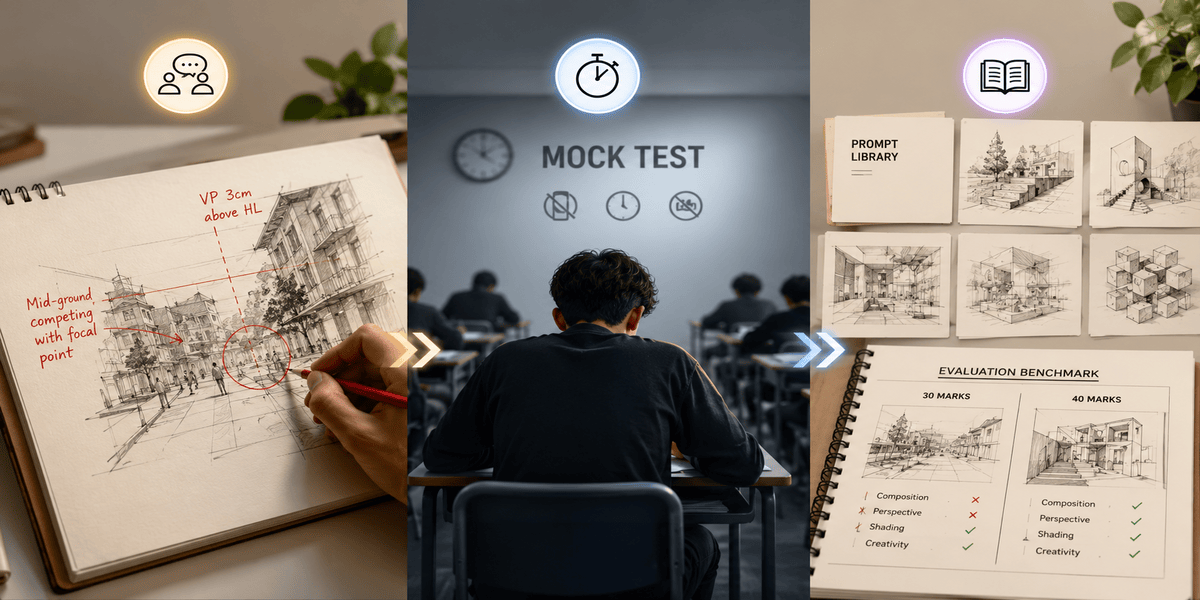
Personalised Drawing Critique: A good NATA faculty member looks at your drawing and tells you specifically what is pulling your score down. Not "your shading needs work," but "your mid-ground is competing with your focal point and your vanishing point is 3 cm off the horizon line." This level of specificity compresses the improvement curve dramatically. What takes a self-study student four months to figure out through trial and error, a coached student can correct in four sessions.
Structured Mock Tests Under Exam Conditions: Coaching centres run full-length mocks that simulate the actual exam environment - including the discomfort of a strange room, unfamiliar paper, and time pressure with no pauses. This matters more than most students realise. Exam anxiety accounts for a measurable portion of underperformance, and the only cure is repeated exposure to exam-like conditions.
Curated Prompt Libraries and Evaluation Benchmarks: Experienced NATA faculty have seen hundreds of student papers evaluated over multiple years. They know which prompt types appear in clusters, which architectural themes recur, and what the difference between a 30-mark and a 40-mark response to the same prompt looks like. That institutional knowledge is genuinely difficult to build alone.
Expert Note: The most underrated benefit of coaching is not the teaching - it is the calibration. Students who prepare alone often have no idea whether their drawings are competitive or just "not bad." Seeing your work placed next to a peer's and graded comparatively resets your benchmark in a way that solo practice never can.
What Percentage of NATA Toppers Actually Took Coaching? The Real Data
The honest answer is: there is no large-scale public dataset on this question. The Council of Architecture does not publish preparation-method breakdowns alongside merit lists. Anyone claiming precise national statistics is extrapolating from a small sample or fabricating the number.
What we do have is directional evidence from coaching centre surveys, aspirant community forums, and architecture college admission data.
Based on self-reported data collected from NATA aspirant communities across platforms including the r/IndiaCampus architecture thread and multiple architecture college fresher surveys, the pattern that emerges consistently is this: a significant majority of students who clear NATA use some form of guided input - coaching, mentorship, or structured feedback - for at least a part of their preparation. Pure self-study from start to finish is the minority path among high scorers, though it is not an impossible one.
The more meaningful data point is this: among students who score above 130 out of 200, a disproportionate share report having received drawing-specific feedback from an external evaluator at some stage. The maths and aptitude scores at that level are more evenly distributed across coaching and self-study students.
The takeaway from this pattern is clear. Coaching does not decide your Part B score. It often decides your Part A ceiling.
Is There a Middle Path Between Full Coaching and Pure Self-Study?
The hybrid approach to NATA preparation is the most efficient option for most students. It means handling maths, aptitude, and general reasoning through self-study, while bringing in structured coaching specifically for drawing critique and full-length mock evaluation.
We identify four components of an effective hybrid plan.
Component 1: Self-Paced Maths and Aptitude Revision NCERT textbooks, official past papers, and free online resources cover this completely. Allocate 90 minutes per day, build a formula revision sheet, and run self-timed chapter quizzes from Month 2 onward.
Component 2: Daily Independent Drawing Practice One 90-minute timed drawing session every morning. No skipping. Build the physical habit of working within a time limit before you bring in external feedback.
Component 3: Weekly Drawing Critique Sessions Submit two drawings per week for evaluation from a qualified NATA faculty member or an experienced architect who understands the exam's evaluation criteria. This can be done in-person or through an online platform. The frequency matters more than the format.
Component 4: Full-Length Integrated Mocks Under Supervised Conditions Take at least one full supervised mock per month. The supervision is the point - it replicates exam-day pressure in a way that solo timed practice does not.
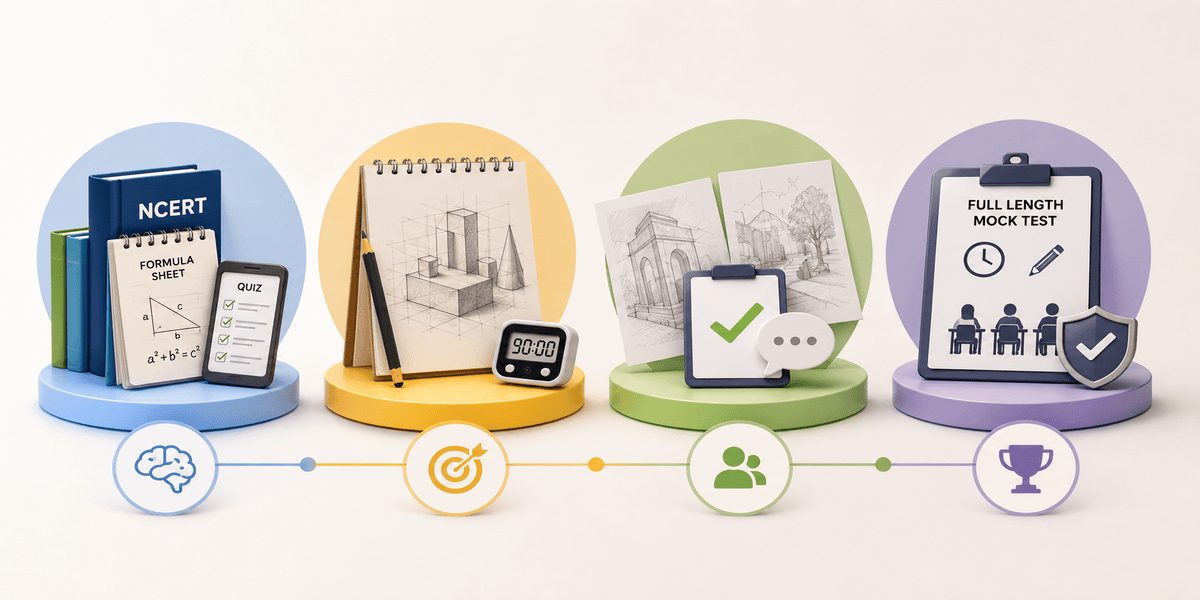
This hybrid model costs a fraction of full-time coaching, preserves the flexibility of self-study, and plugs the one gap that actually separates self-study ceiling from coached-student ceiling: drawing feedback.
How Do You Choose the Right NATA Coaching Centre? An 8-Point Checklist
Not all NATA coaching is equal. Some centres offer genuine expertise. Others offer recorded lectures, generic study material, and a certificate of attendance. Before you pay a rupee, run any coaching programme through this checklist.
1. Do faculty members have architecture degrees and active evaluation experience? NATA drawing faculty should ideally be qualified architects - B.Arch or M.Arch - who have evaluated student papers or have direct NATA examination familiarity. General art coaching is not the same as NATA-specific drawing coaching.
2. Is drawing critique personalised or generic? Ask directly: "Will I receive individual feedback on my drawings?" A centre that reviews your specific work and identifies your specific errors is worth paying for. One that gives the same feedback to every student is not.
3. How many full-length mocks are included? Minimum four full-length mocks across the preparation period is a reasonable benchmark. Fewer than four is insufficient for meaningful score calibration.
4. Is the batch size small enough for individual attention? Large batches (30+ students) make personalised drawing critique structurally impossible. Ask for the actual batch size, not the marketed one.
5. Does the programme cover both Part A and Part B, or only drawing? Verify the syllabus coverage matches the actual NATA exam structure. Some older programmes still teach content that matches outdated exam patterns.
6. Are previous student results verifiable? Ask for names of students who cleared NATA from this centre in the last two cycles. Responsible coaching centres can share this without violating privacy. Vague claims about "hundreds of selections" without specifics are a red flag.
7. Is there a free trial or demo class available? Any coaching programme confident in its quality will let you experience one session before you pay. If there is no trial option, that itself is information.
8. What is the feedback turnaround time for submitted drawings? For online coaching, this matters critically. Drawing feedback delivered five days after submission loses most of its corrective value. Ask specifically: how long does feedback take, and in what format does it arrive?
What Do NATA Students Who Trained With Archi Learn Actually Say?
The most reliable signal for any coaching programme is not the brochure. It is the specific language students use when describing what changed in their preparation.
Archi Learn students consistently report the same three shifts: their drawing compositions became intentional rather than instinctive, their Part B accuracy improved from targeted maths revision sessions rather than general aptitude filler content, and their exam-day confidence was measurably higher after supervised mocks run under actual time pressure.
One recurring theme in student feedback: the moment when a faculty member circled a specific area of their drawing and explained exactly why it was losing them marks. Not a general note. A precise, actionable observation. For most students, that single moment of specific critique produces more improvement than weeks of solo practice. That is what Archi Learn's drawing critique model is built around.
The students who get the most from Archi Learn coaching are not the ones who were already strong drawers. They are the ones who arrived with consistent daily practice already in place and used the coaching layer to refine rather than replace their own effort.
What You Need to Know
Self-study is fully sufficient for NATA Part B (maths and aptitude) when paired with NCERT revision and regular past-paper practice.
The drawing feedback gap is the primary reason self-study students plateau - you cannot identify your own compositional blind spots without external critique.
NATA coaching's real value is in three specific things: personalised drawing feedback, supervised mock tests, and exam-condition calibration. Content delivery is not the differentiator.
A hybrid approach - self-study for aptitude, guided coaching for drawing critique and mocks - gives most students the best outcome at the lowest cost and time investment.
When evaluating a coaching centre, batch size and drawing critique specificity matter more than brand name or alumni count.
The decision between NATA coaching and self-study is not binary. Define your weakest section, then get targeted help for that section only.
When Is Full-Time NATA Coaching Not the Right Choice? Honest Limitations
Full coaching programmes are not the right fit for every student. If your maths and aptitude scores are already strong, paying for a full programme that spends 40% of time on Part B content you do not need is an inefficient use of money and schedule. Students who have less than six weeks available and cannot commit to the full class schedule also extract less value from in-person coaching than from a focused self-study sprint with targeted drawing feedback.
CONCLUSION
The coaching vs self-study debate for NATA has a more useful frame: which parts of your preparation need external input, and which parts can you own yourself? For most students, the answer is that maths and aptitude are ownable - and drawing critique is where you genuinely need a second set of trained eyes. The students who clear NATA at high scores are almost never the ones who did everything alone or the ones who outsourced everything to a class. They are the ones who practised hard every day and got smart, specific feedback at the right moments. If you want to know what that specific feedback looks like for your drawings, and bring two of your recent practice pieces. The session will show you exactly where your NATA coaching vs self-study decision should land.
Need help choosing the right coaching path?
Speak with Archilearn for exam planning, portfolio guidance, and the right study strategy for your goals.

Comment Section
No comments yet.